By Lorenzo Smith
Op-Ed Contributor
Aside from food, water, and shelter, the one thing that a person will most need in life is an education. Of those four necessities, education is the only one that can help ensure a person’s consistent ability to provide him or herself with the other three. It is a sad fact that, however much people and politicians talk about its importance, education in Jamaica is not where it should be.
The state of education in Jamaica cannot be blamed solely on the teachers, the students, or the government. The real problem lies in educational philosophy and the system of student assessment. The current model suggests that students who can regurgitate a series of memorized facts will remember those facts once the test is complete and will have learned what they are supposed to have learned. As a teacher, I am faced with examples of this on a daily basis.
A typical question on a CSEC or CAPE examination paper will ask a student to either examine, analyse, assess or illustrate. These instructions are what educators refer to as the “higher level skills,” the skills that are most absent from our students today. As a teacher, in planning for a lesson, I try to incorporate the following objectives in the lesson: knowledge, intellectual traits and effective/emotional traits. Of the three, I find that it is most difficult for the students to achieve the second objective. What is the point? Students do not know how to recognize and utilize their “higher level skills.” This article aims to look at the importance of critical thinking to the development of students. The article will look at what is critical thinking, why is it important and how can we teach critical thinking in the classroom
Critical thinking skills give students the ability not only to understand what they have read or been shown, but also to build upon that knowledge without incremental guidance. Critical thinking teaches students that knowledge is fluid and builds upon itself. It is not simply rote memorization or the ability to absorb lessons unquestioningly.
Critical thinking products and courses encourage students to think for themselves, to question hypotheses, to develop alternative hypotheses, and to test those hypotheses against known facts. None of this is to say that memorizing facts is necessarily bad. It means only that when rote memorization takes precedence over problem solving, logic, and reason, students suffer.
What is critical thinking?
“Critical thinking is the intellectually disciplined process of actively and skillfully conceptualizing, applying, analyzing, synthesizing, and/or evaluating information gathered from, or generated by, observation, experience, reflection, reasoning, or communication, as a guide to belief and action” (Scriven, 1996).
It is clear from this definition that students will have to be more involved in their education. Students would be required to do more than just note taking. Students will be pulling ideas apart, formulating questions, analysing ideas and formulae. It therefore means that teachers will have to apply a constructivist approach to the delivery of their lessons. In the constructivist methodology the teacher facilitates learning. By using the constructivist approach, teachers will rid students of the notion that the teacher is the keeper of information, or that the teacher imparts knowledge (the case of the “empty vessels to be filled” syndrome).
Components of critical thinking
Critical thinking involves using the cognitive process to discover, to construct knowledge, to verify and to challenge. Critical thinking involves asking questions, defining a problem, examining evidence, analyzing assumptions and biases, avoiding emotional reasoning, avoiding oversimplification, considering other interpretations, and tolerating ambiguity.
These are tasks that students are afraid of, and the question is, why? The resounding answer is that students are yet to develop their critical skills. In my estimation, primary education is falling prey to rote learning. Children are prepared for exams, whether it is the grade four literacy and numeracy or GSAT. These students on entering the high school system where it is more than recollection of facts find it hard to survive. So how do you teach critical thinking to students to solve the problem of rote learning?
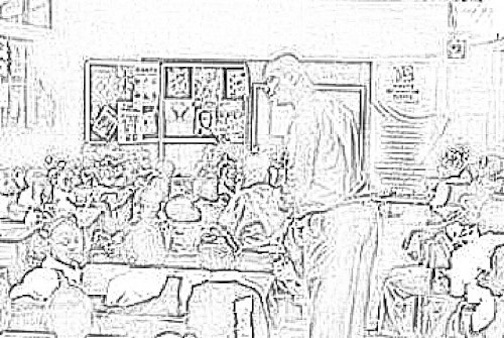
Thinking skills develop best when students are explicitly taught; instead of showing the answers students are taught procedures. Critical thinking can only be developed in a student centered classroom where the teacher is not the center of attention.
Why teach critical thinking?
Students are seen as too often being passive receptors of information. Through technology, the amount of information available today is massive. This information explosion is likely to continue in the future. Students need a guide to weed through the information and not just passively accept it. Students need to “develop and effectively apply critical thinking skills to their academic studies, to the complex problems that they will face, and to the critical choices they will be forced to make as a result of the information explosion and other rapid technological changes. Critical thinking involves questioning. It is important to teach students how to ask good questions, to think critically, in order to continue the advancement of the very fields we are teaching. “Every field stays alive only to the extent that fresh questions are generated and taken seriously.”
It is my strong belief that if more of us as educators were practicing the critical thinking approach, we would see different results in our CSEC and CAPE examinations. We would also see better citizens, people who can reason with a voice of logic. As we plan for a secure and prosperous future, educators must create a people of critical thinkers so that Jamaica can be the place of choice to live, work, raise families, and do business.
Lorenzo Smith is a teacher at The Queen’s School in Kingston, Jamaica.
Note: the opinions expressed in Caribbean Journal Op-Eds are those of the author and do not necessarily reflect the views of the Caribbean Journal.