By Jorge Familiar
CJ Contributor
ENERGY SECURITY is at the top of the agenda for Caribbean leaders and it has been for some time.
With an average cost of electricity four times higher than in rich nations such as the United States, high energy costs are not only a daily hardship for Caribbean people, but also one of the key bottlenecks for unleashing economic growth and prosperity in the region.
While the recent drop in oil prices is releasing some of the pressure, it also represents an opportunity to look into strategies for increasing energy security in the region. This means investing in clean energy, and saving energy through more efficient production and consumption.
To help achieve this transformation, Caribbean leaders and leading energy partners agreed to pursue a joint regional framework for energy development at the Caribbean Energy Security Summit last week in Washington D.C.
Most small Caribbean countries, particularly the Eastern Caribbean States, depend almost entirely on petroleum to supply their electricity needs — with oil and gas expenditures taking between seven to 20 percent of a country’s GDP.
The region has achieved nearly universal electrification and almost all households are connected to the grid, with the exception of Haiti.
After the devastating earthquake that hit Haiti’s capital city of Port-au-Prince five years ago, the availability and reliability of modern energy services remains crucial to the recovery and sustainable development of the country, where only 28 percent of the population has regular access to electricity.
When walking in the streets of Port-au-Prince or Basseterre in St Kitts and Nevis, you can now see that many of the street lights are solar.
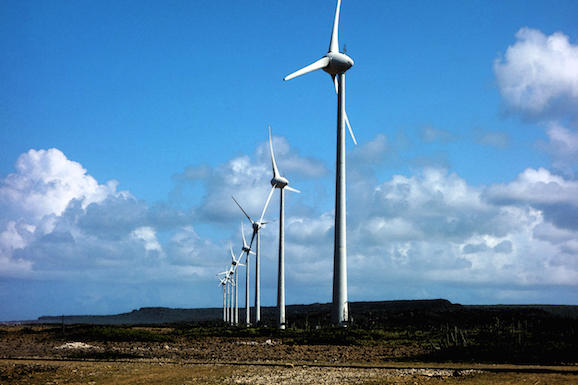
The Caribbean region has a diverse and large renewable energy potential, including not only solar, but also wind, geothermal, biomass and marine energy. While solar and wind are intermittent, they can be used in combination with renewable geothermal power or clean natural gas power.
A recent World Bank study showed that seven Eastern Caribbean countries have potential for geothermal energy generation, which would help reduce costs for their oil-dependent electricity sector.
On the island of Guadeloupe, the La Bouillante power station is already generating 15MW by means of geothermal energy.
Exploratory drilling and preparatory work is happening in Dominica, Grenada, Monserrat, St Lucia, St Kitts and Nevis, and St Vincent and the Grenadines.
Yet oil and gas based electricity generation will continue to dominate for some time. Another priority agreed by Caribbean governments during the Summit is to reduce inefficiencies in their energy systems by saving energy and reducing waste.
What this means is modernizing electricity distribution companies and grid systems, but also on the consumer side making buildings more energy efficient and replacing old equipment and appliances, using for instance high efficient air conditioners and LED light bulbs.
Today nearly one in two households in Barbados is using solar water heaters.
Throughout the island, you can see solar panels and water heaters sprouting from government buildings, hospitals, businesses and thousands of bright colored homes. The solar industry has become an important source of green jobs in the country as Caribbean companies have led the regional manufacturing effort for solar water heaters.
This green movement is also catching up in other islands including Aruba where the government is working with the hotel industry and investing in more efficient and clean technology.
By the end of the year, Aruba will be using almost 50 percent renewables and its vision is to reach 100 percent by 2020.
The World Bank Group is working with Caribbean governments in supporting their efforts to modernize the power sector with investments and regulatory changes affecting both power generation and energy efficiency to reduce retail tariffs, increase the reliability of supply by diversifying and using renewable fuel sources, as well as enhancing service delivery.
Such reforms are critical to improve the business climate. For instance last year, Jamaica jumped 27 ranking positions in the Doing Business indicator partly by making electricity less expensive as a result of lower external connection cost.
Many donors and investors are supporting these reforms and this is why a Caribbean Energy Investment Network was also proposed this week during the Summit, to develop a new architecture of cooperation for energy security in the region.
This new network would not only support greater cooperation across islands and between governments, donors, international financing institutions, and investors, but would also help identify concrete steps that Caribbean nations and development partners can take to attract investments for sustainable energy initiatives.
By coming together and agreeing to build a common platform, Caribbean countries and their partners showed their commitment to make the energy sector more efficient, sustainable and green. This is just the first step to unlock the energy potential of the Caribbean. We now need to build on the momentum.
Jorge Familiar is the World Bank Vice President for Latin America and the Caribbean