Ilio Durandis: Haiti Does Need an Army
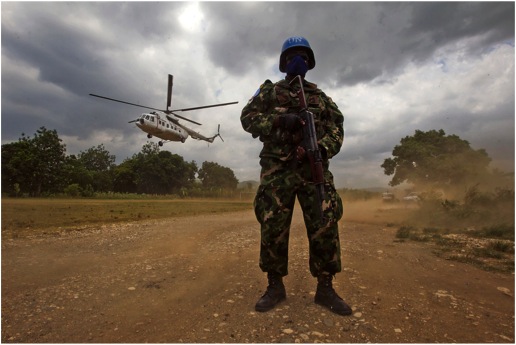
Above: a UN training exercise in Haiti (UN Photo/Victoria Hazou)
By Ilio Durandis
Haiti’s army was disbanded in 1995, shortly after the first return from exile of President Jean Bertrand Aristide. Ever since, the reinstating of the army has been a subject of much talk, and little action, until last week.
President Michel Joseph Martelly, in a leaked-document, has detailed a plan to re-establish the Haitian Army—a document that is already causing much debate. Even before the leaked-document surfaced, The New York Times and Time Magazine online, among other mainstream media, had written Op-eds decrying the thought of a new Army in Haiti.
Last week, Tim Padgett of Time wrote: “Why Haiti Does Not Need an Army,” where he tried to make a few points against the need for the army. Among some of his claims are the President’s past affiliations with some of the former soldiers, an argument that many have made during the last electoral campaign. He also argued that having an army in Haiti is kind of a flawed mindset still plaguing Latin America and the Caribbean, and that the Army does not fight crimes.
In Mr Padgett’s article, he advocated for a stronger police force, and an effective judicial system to prove to Haitians that they do not need troops on the street to keep order. This argument is understandable, but it failed to point out that a police force could never do the job of an army.
It is easy to say an army in Haiti would be bad news, if the argument is based solely on the past. There is no denying that the army of the past was brutal, oppressive and definitely a cancer for the progress and freedom of the people. However, if there is anything the absence of an all Haitian armed forces have taught us in the past 16 years, it is that the sovereignty of the country has been greatly compromised, and that not having an army has been a part of the identity crisis from which most Haitians suffer.
Haiti won its independence on the weight of a revolutionary army, composed of brave men and women who believed that the pursuit of freedom demanded the ultimate sacrifice. The presence of a Haitian army on Haitian soil is a clear reminder to everyone that Haitians believe in the notion of self-government. The army can be an institution of national pride, which can help boost Haitian morality and self-determination to build back a better country.
Here are a few of the reasons that I support a new army in Haiti, and why I think it would be very beneficial to the country’s long-term stability and prosperity:
• Defending the integrity of the territory and all its natural resources
• An institution that can respond to major disasters (earthquake, hurricane, etc.)
• Embodying the spirit of the founders of the nation.
• Responding to all sort of threats against the interest of the nation.
• Reinforcing the power of the other security forces, whenever appropriate.
It is up to the elected officials to apply the law of the land, and in it is the recognition of the Haitian Armed Forces. Creating this new army cannot be rushed, and different sectors of the population must have a chance to opine on this subject.
In my opinion, this new army must be shaped with young Haitian professionals, more specifically people who are younger than 35 years old and who have never served in a previous security force in the country. It must be a new beginning with a crop of new young leaders. To avoid repeating the same mistakes of the past, a complete break from those individuals with previous Haitian military or police experience is necessary.
The recruiting of the first class must rely heavily on the best and brightest students attending the public educational system, and convince them of the reasons why serving in this new military would be an honorable thing to do. It is also important not to rely on only foreign aid to help build this new army.
The Haitian government must make the case to the people as to the importance of this new army. It must be funded with Haitian money. The opponents of the Haitian army often want to use the economic status of the country to point their fingers as to why Haiti definitely does not need an army. It is true that today the country faces many pressing issues, such as finding ways to fund educational programs for all its children, solving the current housing crisis, the sub-human public health system, sanitation, jobs, and basic security services that should be handled by a strong police force.
As I see it, all these facts are even more convincing of the reasons why an army must exist in Haiti. If the new army would include engineering corps that can help build water dams, flood gates, roads in rural areas, irrigation systems; have the capacity to prevent people from continuing with the destruction of the environment and be the institution that exemplifies the role of individual duties in the society. A strong army presence would be a welcoming sign for all investors.
If Haiti is not ready for an army today, then why is presence of the United Nations Mission to Stabilize Haiti, better known as MINUSTAH, a necessity? A new army with the proper training and ethics can take the lead to secure and protect the Haitian state.
Ilio Durandis is the founder of Haiti 2015, a social movement for a just and prosperous Haiti. He is a columnist with The Haitian Times.
Note: the opinions expressed in Caribbean Journal op-eds are those of the author and do not necessarily reflect the views of the Caribbean Journal.