
Cigars: The Heart and Soul of Cuba: An Interview with James Suckling
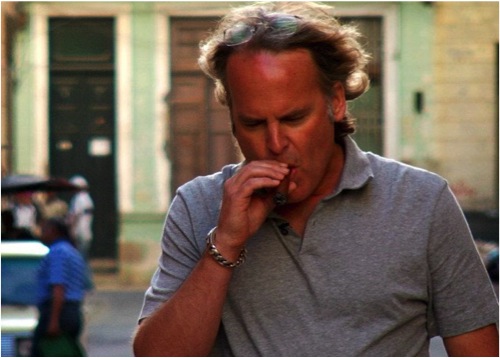
By Alexander Britell
While Cuban cigars are renowned the world over for their quality and their history, the process of how Cuban cigars are made – and just what they mean to the Cuban people – have remained largely unexplored, particularly in film. But thanks to the efforts of James Suckling – one of the world’s leading experts on cigars (and wine), viewers of his new film, Cigars: The Heart & Soul of Cuba, get a unique glimpse into the culture and production of habanos. Suckling, the former European Editor at Cigar Aficionado and now the pioneer of a new media venture, JamesSuckling.com, that provides cutting-edge analysis of wine and cigars, guides the film, which was written and directed by noted Canadian director James Orr. To learn more, Caribbean Journal talked to Suckling about Cuban cigars, their importance to the Cuban people and what makes them one of the most sought-after products in the world.
What motivated you to make Cigars: The Heart and Soul of Cuba?
I always wanted to do a movie on Cuban cigars, because I’ve been going [to Cuba] since the early 1990s as the European Editor of Cigar Aficionado. So when I left the magazine, one of the main reasons was that I wanted to do this movie on Cuban cigars.
What was the process like making the film?
The process was actually a lot easier than one might expect. I know the subject very well, after writing about Cuban cigars for almost two decades, and then I was working with my friend, director James Orr [Sister Act; Three Men and a Baby], who is a very accomplished Canadian film director, and he smokes cigars, and he’s one of my best friends. So we didn’t really have a script. It was all done spontaneously, and it went really well. We had a local film crew, and worked with an English guy who has a travel business there, so he also helped in the production. It was a really fun project, with friends, and it came out really well.
What do cigars mean for Cuba?
I think it’s almost like a religion for Cubans. They have such pride in cigars, and the tradition, the process, it’s part of their culture, so it’s sort of like when you think of wine, with Frenchmen, or pasta with an Italian.
You’ve been traveling to the country for some time now – what does Cuba mean for you?
There’s something mysterious about Cuba. The people are educated, the histories are amazing – going back to Columbus, and everything is just so beautiful with the colonial architecture. It’s like going back in time.
Did you learn anything in making the film that you didn’t expect?
Because when we filmed it, we didn’t really have a script, in an interesting way, we didn’t know completely what we had. We went though the process of cigars, but it was really a journey to find out why Cuban cigars are the best in the world, why they are so exceptional. In the end, after five days of doing the film, it was really my sort of journey, into finding out why. Obviously the things are the soil, the climate, the processes, the history – all of this accounts for the greatness of Cuban cigars. But in the end, what we realized was that it was the people, the Cuban people, that make it with such passion and love.
How do cigars impact other facets of Cuban life?
I don’t think it impacts it much at all – other than that it’s an accepted pleasure and pastime in Cuban life. It’s also used in their Afro-Caribbean religion, Santeria, but it’s just something that a Cuban enjoys – like a good glass of rum – it’s just sort of part of life.
How much has the quality of Cuban cigars changed over the years?
From about when I started going there in the early 90s, the quality was amazing. Production was pretty small. And then, by around 1998, they started over-producing, and the quality went down until about 2001. Then they started really focusing on quality, and fine-tuning some of the process. Now, I think the quality is back up to where it should be.
What do you see going forward for Cuban cigars vis-à-vis the United States?
Well, if the embargo were dropped, they might be able to sell their entire production. Right now, estimates are that they export about 80 million to 100 million cigars a year, and maybe as much as a third of that goes to the US anyway – whether it’s Americans traveling, buying them, or them being smuggled in. America is probably now the biggest consumer of Cuban cigars.
What do you ultimately want people to take away from this film?
I hope that the film can give people the feeling of how Cubans are, and how Cubans are very much like all of us, with the same aspirations and feelings, that this sort of forgotten island for many people actually has much more in common with us than we may think. I think the biggest thing is, when people see the movie, they can ‘t believe how much work goes into the production of Cuban cigars – from growing the tobacco – where the tobacco may have been handled over a hundred times through making the cigar, and can go through 200 processes. So it’s really interesting – I had no idea about how much went into making the cigar, and in a way I can’t believe how inexpensive they are. I think what I liked, too, about the movie is that by seeing the process, seeing the people behind it, you really get an idea that, in this age of internet and Twitter and Facebook, that there are still products like Cuban cigars that are really hand made, that are artisanal products, and I think this is really important.