Sylvan Jolibois: Haiti’s Second Revolution
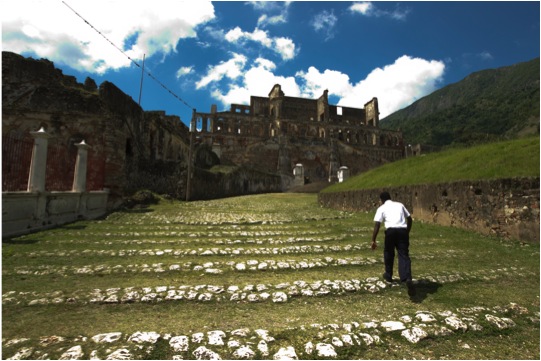
Above: a man climbs the steps at the 200-year-old palace of King Henri-Christophe of Haiti, near Cap-Haitien (UN Photo: Victoria Hazou)
By Sylvan Jolibois, Jr
Op-Ed Contributor
Having recently celebrated its second century as an independent nation, the republic of Haiti finds itself both at its lowest point, as an economically struggling entity, and at its most advantageous position politically, given the international aid committed to its future. In a Kafkaesque way this paradox symbolizes the existential truth of the first black independent nation in the western hemisphere.
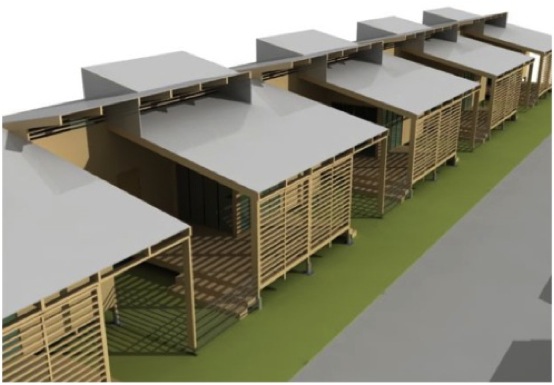
However, the golden opportunity to exploit this dichotomy will be wasted if Haiti and its various internal sectors fail to take advantage of the $11.5 Billion of aid the International community has pledged over the next ten years. The various actors in the process, be they political, economic, labour and/or societe civile, must engage in an honest appraisal of their historical shortcomings and seek to create a road map for short term and long term development. The task is extremely difficult, but they must realize that the primary mechanism to achieve such an objective must rest on the planning and construction of the physical infrastructure of Haiti at both the urban and rural levels. This infrastructure would not only address the transport sector, but the tourism, education, health and industrial sectors as well.
The( re) building of the physical infrastructure of Haiti remains the most effective, if not the unique, mechanism through which the vast majority of Haitians will be able to remove themselves from the abject poverty they find themselves in. That physical (re)construction, which reflects the idea of past and current presidents to convert Haiti into a large chantier (a big construction site) will have greater impacts on both the short term and long term aspirations of the nation. Indeed, while it can be convincingly argued that investments in other critical sectors, such as education, health, justice and agriculture, are absolutely necessary, what is difficult to deny is the advantages of prioritizing the investments in physical infrastructure. By and large, the economic multiplier effect of construction far outweigh the ones for the other sectors of the economy. That is why for example, the Obama administration in the United States is banking its political future on public investments in physical infrastructure and green energy.
There is, additionally, a time lag component to be found in education, health, agriculture and industry. When investments are made in education, primary and secondary for instance, the clear benefits may be realized 12-15 years in the future. When investments are made in the health sectors, there is a shorter time lag for recuperation and convalescence of the affected population, but the result may yield a healthier but still unemployed person. Investments in the agriculture sectors are even more challenging, in as much as they depend on a variety of factors, some uncontrollable such as weather, to produce a sustainable positive outcome. The poor state of equilibrium to be found in the agricultural sector—e.g., soil erosion, lower priced and higher quality imports of basic agricultural commodities, a social/institutional construct that makes small subsistence agriculture on carreaux de terre the norm—creates the situation where massive short term investments in that sector may be more of a rational gamble than an effective and efficient planning strategy.
Beyond these clear advantages, investments in the hard sectors of development, such as physical infrastructure, have also the potential of creating new opportunities for women. This sector of the population has been recognized, in both the theoretical and empirical literature, as a key factor in the long term development of a nation. As an example, in Haiti, a quiet revolution has been occurring in the Centre National des Equipements (CNE), the unit responsible for managing all heavy construction vehicles for the government of Haiti. Fifty two percent of CNE employees are women and they occupy almost every employment position within the organization. You will find them operating all the humongous vehicles, from excavators, to rollers. Similarly, you will also find a substantial number of women in the debris clean-up projects associated with post earthquake cash-for-work programs.
Finally, the infrastructure investments in the tourism and industrial sectors can be considered as immediate benefits to be accrued at two levels. The first one is to be found in the employment opportunities to be generated in the building of roads, ports, airports, water and waste water collection and distribution systems, hotels, industrial and manufacturing centers. The second immediate benefit will be seen in the quick returns on investments obtained from revenues derived from increases in tourism travel from the Haitian diaspora as well as from international visitors.
To be effective, such a physical infrastructure dominated agenda must be accompanied by the implementation of clear policies of decentralization at the national level. This will be a very difficult task to achieve in the absence of a federalist framework, since the Constitution of 1987 maintained a very strong dependency relationship between the smallest unit of local government, the commune, and the highest unit, the national government of executive, legislative and judicial powers. However, regardless of the ultimate institutional mechanism chosen by the political leadership, one fact remains clear, the physical reconstruction of Haiti holds both the short term and long term solutions to the problems plaguing the nation. An employed populace is one which may better satisfy its education and health needs.
Sylvan Jolibois, Jr, PhD, is Associate Professor of Civil and Environmental Engineering and Urban Regional Planning,
College of Engineering and Computing at Florida International University in Miami.
Note: the opinions expressed in Caribbean Journal op-eds are those of the author and do not necessarily reflect the views of the Caribbean Journal.