
How Does the Oil Price Decline Affect the Eastern Caribbean?
By Runy Calmera
Op-Ed Contributor
Oil prices have decreased considerably from above US 100,- a few years ago to almost $40 USD. As the Eastern Caribbean islands are heavily dependent on imports of oil, in this short article we will analyze how dependent these islands are on oil.
Consumption of Refined Petroleum Products
Based on the information on the US Energy Information Administration website (eia.gov) one can calculate the average consumption of refined petroleum products between 2008-2013.
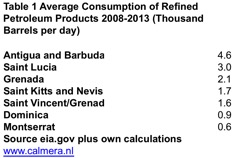
In the table you see that Antigua and Barbuda has consumed about 4.6 thousands barrels of oil per day on average, while Montserrat has the lowest consumption at 0.6 thousands barrels of oil per day on average between 2008-2013.
Value of Consumption
Of course, the total average number of barrels of oil per day consumed does not show us how much money was consumed. If you take a $40-per-barrel price per day as an assumption, the total value of consumption is shown in the next table.
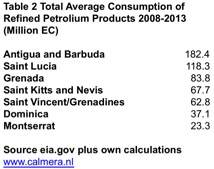
Antigua consumes 182.4 million EC dollars of refined petroleum products per year on average between 2008-2013, while Montserrat consumes on average EC 23 million of refined petroleum products per year.
Imports of Goods and services
How much are the total imports of goods and services for the Eastern Caribbean Union islands?
For this we have used data about the balance of payments of the Eastern Caribbean Central Bank (eccb-centralbank.org). This data was converted to only show the total imports of goods and services.
In the next table you see the total imports of goods and services for the islands we analyze in this article.
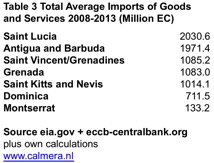
Here the order of the islands changes. Saint Lucia has the highest imports of goods and services on average between 2008-2013 at $2 billion EC, while Montserrat has the lowest number of imports of goods and services per year at EC $133.2 million.
Consumption of oil as percentage of total imports of goods and services
If we take the total consumption of refined petroleum products and divide that with the total imports of goods and services and rank the islands we find the following table.
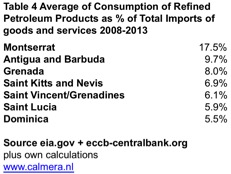
We see that Montserrat has the highest percentage of consumption of oil as a percentage of total imports at 17.5 percent, while Dominica has the lowest percentage. It appears that the islands of the Eastern Caribbean Currency Union have a dependency on oil between 5.5 percent and 17.5 percent on average during 2008-2013. This means that a significant portion of their imports are for oil.
When the oil prices decrease this will ease their consumption (and imports) bill, if you take as an assumption that they will continue to consume the same volume of barrels of oil —E.g. prices go down while the volume stays the same, means that the total value to be paid will decrease.
Total Exports of Goods and Services
How much are the total exports of goods and services for the Eastern Caribbean Union islands?
For this we have used again data about the balance of payments of the Eastern Caribbean Central Bank (eccb-centralbank.org). This data was converted to only show the total exports of goods and services.
In the next table you see the total exports of goods and services for the islands we analyze in this article.
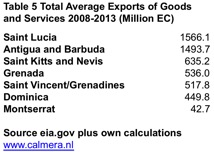
Saint Lucia has the highest exports of goods and services while Montserrat has the lowest contribution to the total export of goods of services of the Eastern Caribbean Currency Union. While you also need to take into account the financial and capital account to come to conclusions, this gives a first indication of the exports of goods and services for the islands.
Consumption of oil as percentage of total exports of goods and services
Finally, let’s look at the total consumption of oil as a percentage of total exports. Why? Because normally the small island developing states (SIDS), of which the Eastern Caribbean Union islands are a part, are very open economies. Therefore they have to earn dollars by exporting to be able to import oil products. If their export sectors are not performing, this means that their ability to import and consume oil will be lower. In the next table you see the total consumption of oil products as a percentage of total exports of goods and services of the islands.
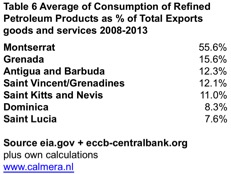
Again the order of the islands changes. Now Montserrat has the highest average as a percentage of its exports, while Saint Lucia has the lowest. This means that Montserrat spends more of its export dollars in consumption and imports of oil than Saint Lucia.
Learn more in Free Online Seminar
Runy Calmera is hosting a free online Seminar about the 7 ways the oil price decline is going to affect your income in 2015 – and what you can do about it.
Next week on Tuesday February 3, 10:00-11:00 Atlantic Time Zone, Calmera will give a free online seminar about this topic. To learn more, reserve your seat for this free event at: http://www.calmera.nl/free-online-seminar-oil-price/
Runy Calmera is an economist, consultant, trainer and coach on economic analysis and policy for the 52 small island developing states (SIDS). You can find out more on www.calmera.nl and on Facebook at www.facebook.com/policyinparadise.
Note: the opinions expressed in Caribbean Journal Op-Eds are those of the author and do not necessarily reflect the views of the Caribbean Journal.