Mark Gilbert on Designing Jacmel and How Haiti Can Learn from New Orleans
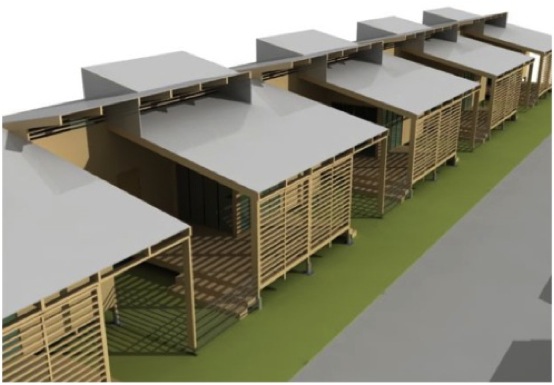
Above: one of the firm’s designs for housing in Jacmel
By Alexander Britell
The team at Vienna-based architecture firm trans_city_architecture is doing its part in redesigning and reconstructing the city of Jacmel, Haiti. Together, Mark Gilbert, Christian Aulinger and Georg Kogler have developed a comprehensive plan to reconstruct the city, based on several novel ideas of a system of prefabricated houses, or rapid-response housing. Caribbean Journal talked to Gilbert about the challenges of designing in Haiti, how the team learned about Haitian design from the typologies of New Orleans and the most important design issues in rebuilding Haiti.
How did you come up with this project?
Well, we had developed the concept of what we call rapid-response housing about two years ago, before the project in Jacmel had begun, and we had actually received financial support from the city of Vienna to develop this concept. It’s a management and construction system, which allows us to plan, build and manage the process of large-scale reconstruction; the Jacmel proposal was our first large-scale pilot project.
What are the challenges of designing the reconstruction of Haiti?
Well, the challenges are probably three-fold. The first is finding and proposing solutions. We believe that design solutions begin with the way that people live, and the ways people will use the buildings. So we had begun a series of research investigations into the building traditions in Jacmel, and Haiti in general, and built upon a project we had begun before in New Orleans as well. We did a lot of work on typologies, and what’s very interesting about that is that the typologies in New Orleans have all been derived from building practices in Haiti — because about 200 years ago, Haiti was the growing place in the Caribbean, and a lot of these typologies had been developed there. So we were able to take what we learned in New Orleans and apply it to ideas for houses in Jacmel. That was one step.
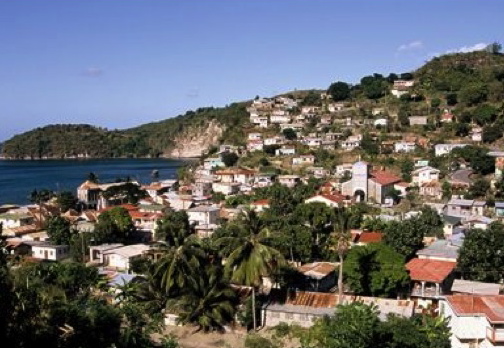
The second step was the question of the ecology of the site — we had visited the site and done some intensive research about ecological problems in Haiti, and one thing that came up very quickly was the necessity of building in a very particular way to this site, which is rather hilly and difficult site, but a beautiful site as well. And very quickly, we came across the idea that we would need to include reforestation and agriculture as important aspects of urban planning. The third aspect is, of course, the whole situation of building in Haiti, and building within the internal aid structure. I have to say that was probably the most difficult aspect of the whole thing, because the reconstruction in Haiti is a very convoluted process, and that’s what we’re struggling through. We’ve received preliminary approval for the project from what’s called the IHRC, or Interim Haiti Reconstruction Committee, and they’ve determined that the project is of good quality and answers the specific needs of the site. But the funding process has turned out to be a very difficult proposal — I think that’s what everyone’s seeing in Haiti — and it’s unfortunately moving ahead very slowly.
How does the design mindset change in reconstructing a country?
I think that a lot of projects that we’ve seen being done, often by young architectural groups, are very attractive solutions. But what we have specifically tried to keep our eye on was the necessity to build as economically as possible, while still answering the site’s needs. Urban space and the quality of the city was important, as was the quality of the quality of the materials, and above all hurricane and earthquake stability. I think that I have a lot of respect for a lot of proposals I’ve seen from our colleagues. But think the most important thing we have to keep in mind is that this is not a situation where we can concentrate ourselves on realizing our own personal design ambitions as such; instead, we have to remain focused on the needs of the local people, and the problems of working within a very difficult context — Haiti financing, reconstruction in general — these were the parameters we were most concerned with. If the project’s beautiful then we’re very happy, but if the people are very happy living there, that’s the most important thing to us.
How did you end up choosing Jacmel?
Actually, Jacmel more or less chose us. We had been working on our management and construction system, which we call “Emergency Room.” It’s the system that we developed for rapid-response housing. We’ve been involved in a series of professional networks which are pursuing similar ideas, and we were at a conference in Vienna and were approached by our NGO, which is Green Containers International, an NGO that is based both in Germany and in Santo Domingo, and has the necessary license to operate in Haiti through that. They had seen a presentation on our system, and called us up and said, “let’s work together.”
Have you considered expanding to other parts of Haiti?
We would be open to it. We would be very glad to present our proposals to any other interested parties, and we believe that the proposal in itself is general enough that it would be applicable for other cities, even though it’s particular enough to fit Jacmel. But if there’s interest in Port-au-Prince, or Leogane, we are very glad to talk to any responsible party who’s interested in working with us and our system. We have a very strong support network within the Austrian government and industry, and there’s very strong interest within Austria to be involved in the reconstruction in Jacmel. We have a great network and we’re very glad to talk to the responsible people interested in working with this network.
What is the most important issue in redesigning Haiti?
Well, I think it’s not one most important thing. But to start with, the most important thing is getting good houses and sanitary conditions in place for the people of Haiti — that’s the first and foremost problem. And that is our main focus. The second focus is to do it in a way that will last. I’ve seen a lot of quick solutions in my visits to Haiti, and I think it’s important not to think about today and tomorrow alone, but also about how people will be using these settlements in 10, 15, 20 or even 50 years. So we have to be quick, but also think long-term. The third is that we need to create settlements and houses that fit the needs of the people of Haiti, ones that they can identify with; we also need to involve them in the production of their house as well. If you work on your house, you’ll become attached to it, and you will define yourself through it, and that is a very important part of the process, we believe. That is what makes something work in the long term.